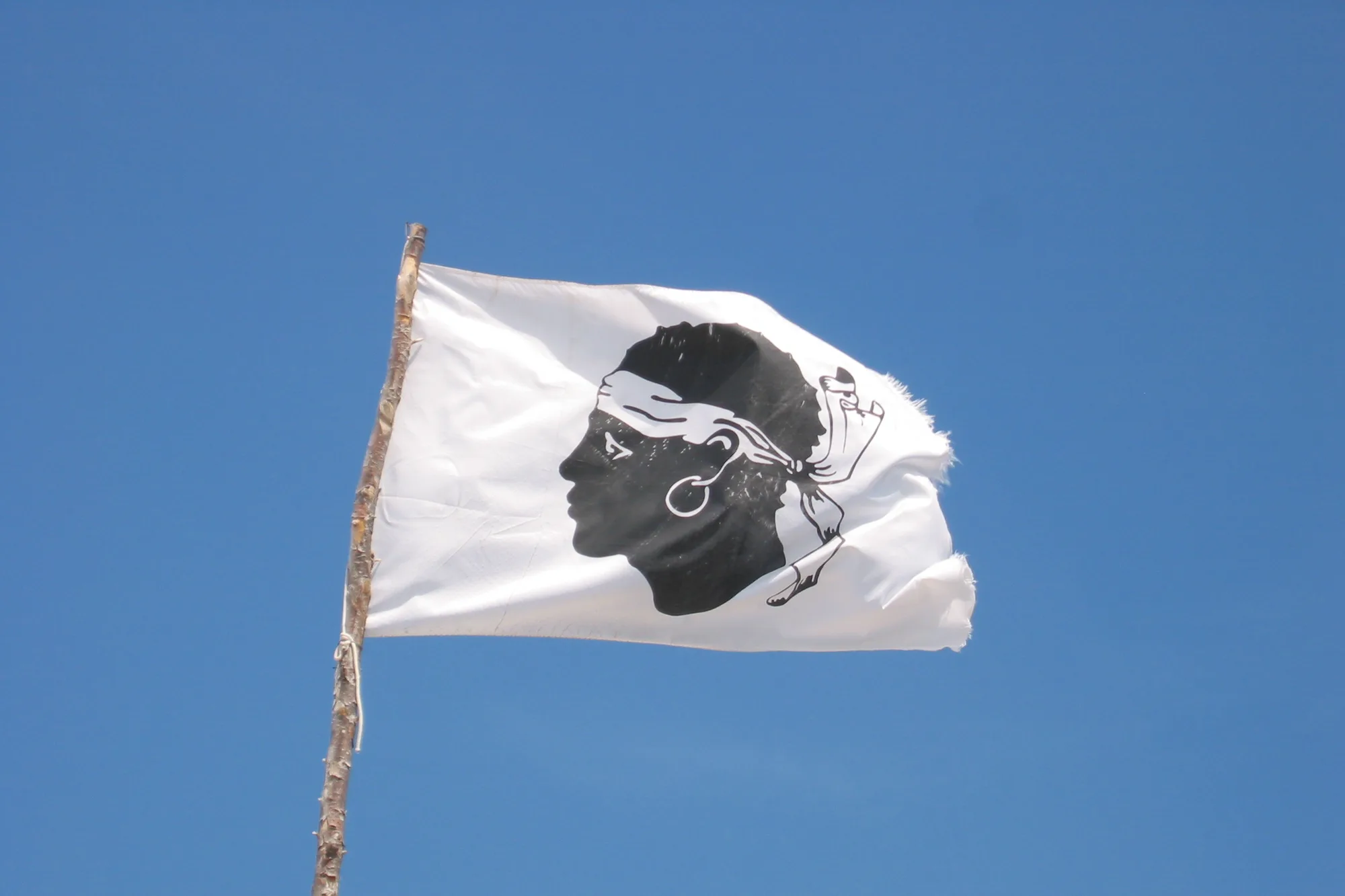
The Corsican flag, a bandera, shows a black Moor’s head, in profile, on a white background. A white band encircles the forehead and is knotted behind the head. In Corsican, it is called the testa mora. Its history mixes dated facts with stories handed down without proof: this page separates the two, and presents the points on which historians disagree as hypotheses.
What does the Corsican flag mean?
Two readings of the flag overlap. The first comes from heraldry: the Moor’s head is a medieval emblem, from the Crown of Aragon, which stood for Corsica in armorials long before the island adopted it. The second is political and dates from the 18th century: according to tradition, the band raised onto the forehead means that Corsica has opened its eyes and freed itself from Genoese rule.
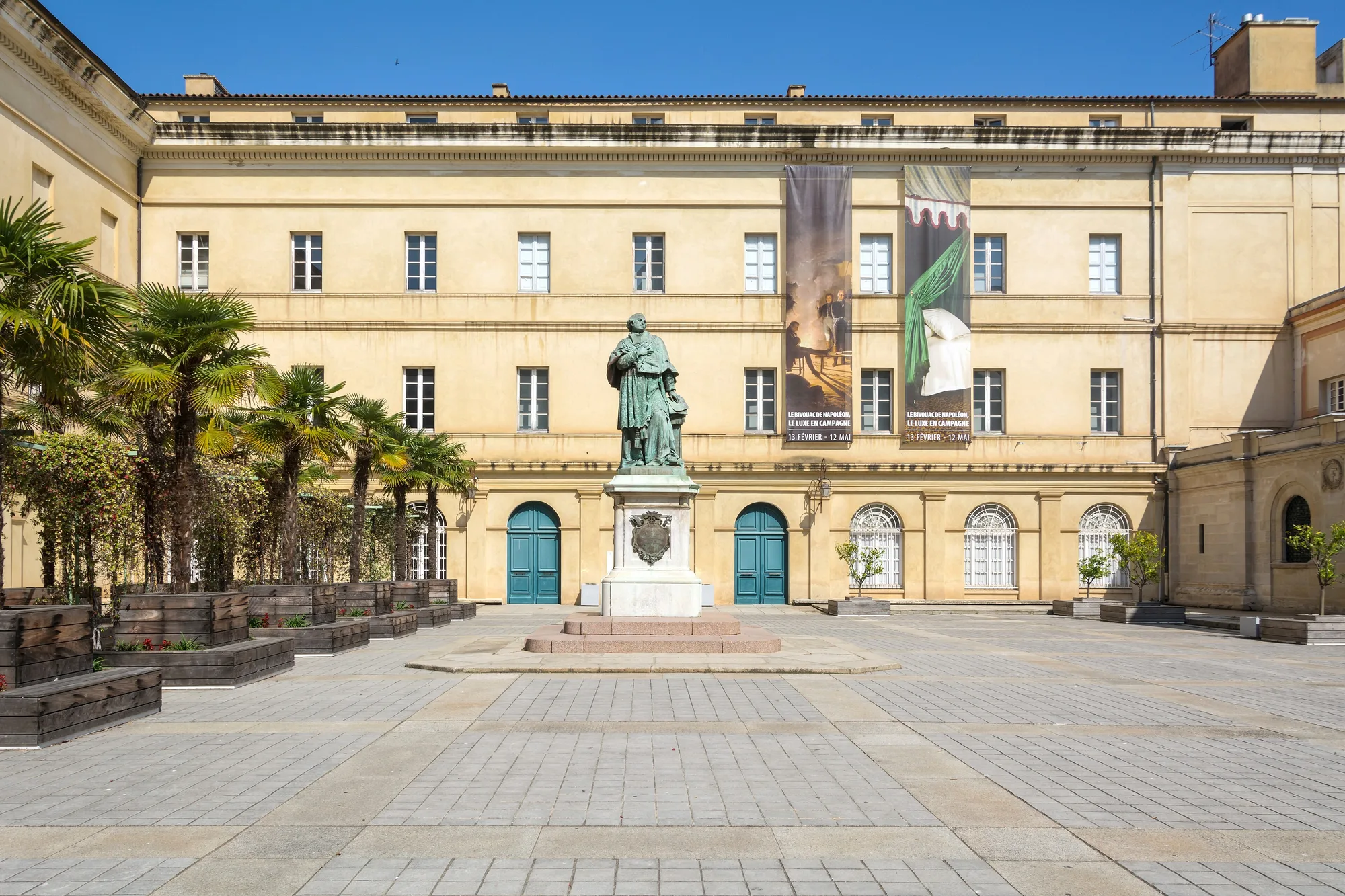
The Musée de la Corse (Museum of Corsica), in Corte, devoted part of its exhibition ‘E Figure di a Corsica’ to the testa mora, presenting it as the island’s main emblem.
Why a Moor’s head? The hypotheses
The Aragonese heritage
The most widely accepted hypothesis links the Moor’s head to the arms of the Crown of Aragon: a cross of Saint George with a Moor’s head in each of its four quarters. The earliest known example is a seal of King Peter III of Aragon, in 1281. Spanish tradition connects the four heads with the victory of Alcoraz in 1096, when Saint George is said to have appeared to the Aragonese troops; this is a legend, and specialists disagree on the real origin of the motif.
In 1297, Pope Boniface VIII created a Kingdom of Sardinia and Corsica for James II of Aragon. Aragon conquered Sardinia, but its rule over Corsica remained nominal: the island stayed largely under the influence of Genoa.
The first record for Corsica
At the end of the 14th century, the Gelre Armorial, a collection of European coats of arms, represents Corsica with a Moor’s head, among the states of the Crown of Aragon. The eyes are uncovered and the band runs above them. In the 16th century, a map by the geographer Mainaldi Galerati used the Moor’s head as the emblem of the island.
Other readings
Several legends make the head that of a Saracen leader defeated by the Corsicans; none is based on a document. Some writers see it as Saint Maurice, a saint depicted as a black soldier; the hypothesis is still debated. In 2024, the historian Michel Vergé-Franceschi devoted a book to the question, Aux origines de la tête de Maure (On the origins of the Moor’s head, Albiana), in which he argues for several origins.
Why the band? Over the eyes or on the forehead
In 1736, Theodore von Neuhoff (Théodore de Neuhoff), proclaimed king of Corsica, used a Moor’s head with blindfolded eyes.
The most widespread story credits Pasquale Paoli (Pascal Paoli in French) with raising the band onto the forehead, to show that the Corsicans now saw clearly and were no longer subject to Genoa. Other versions give the credit to another leader of the time. Several historians doubt that this change ever happened: the band is already on the forehead in the Gelre Armorial, four centuries earlier. The meaning attributed to Paoli is therefore a matter of tradition, not established fact.
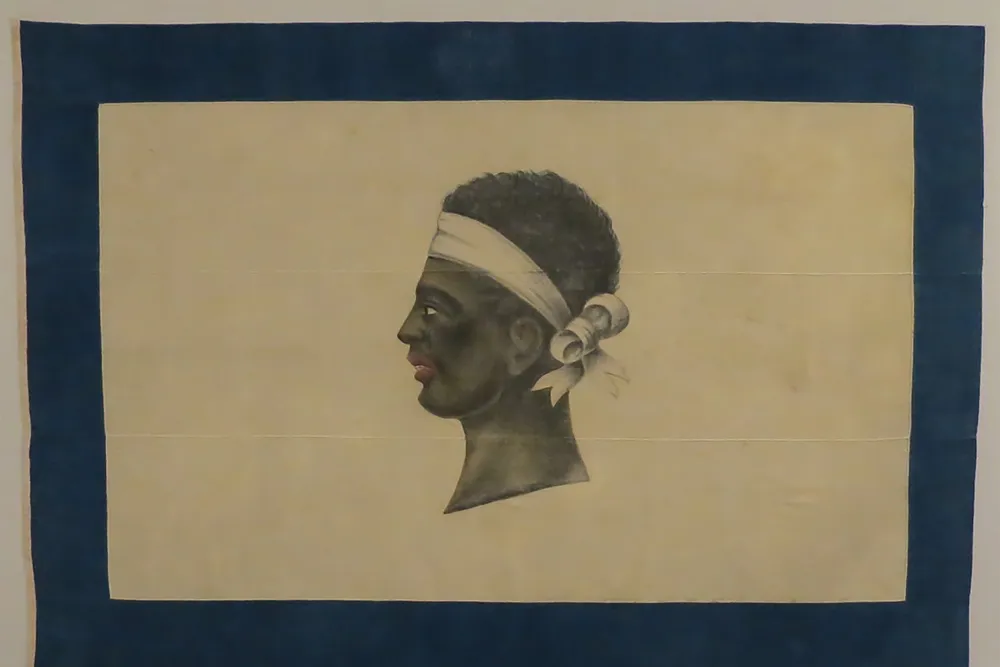 Photo : Unknown authorUnknown author, Public domain, via Wikimedia Commons
Pasquale Paoli and the adoption of the flag
From 1755 to 1769, Corsica governed itself under Pasquale Paoli, elected general of the nation in 1755, with Corte as its capital. The sources date the choice of the Moor’s head, with the band on the forehead, as the emblem of Corsica to 1755. On 24 November 1762, a consulta held in Corte, the assembly of the Corsican nation, described the official flag.
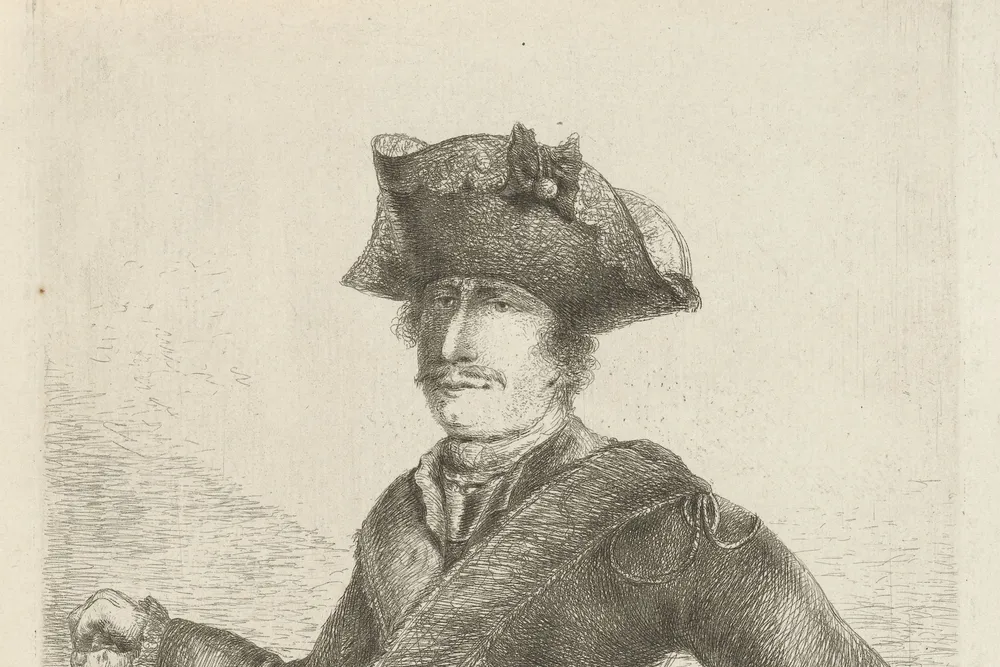 Photo : Rijksmuseum, CC0, via Wikimedia Commons
In 1769, Corsica came under French rule and the flag ceased to be that of a state. It reappeared under the Anglo-Corsican Kingdom, from 1794 to 1796, when the Moor’s head, with uncovered eyes, was combined with the British arms.
The flag of Corsica today
Today you see the Moor’s head flag flying outside town halls and public buildings, often next to the French and European flags.
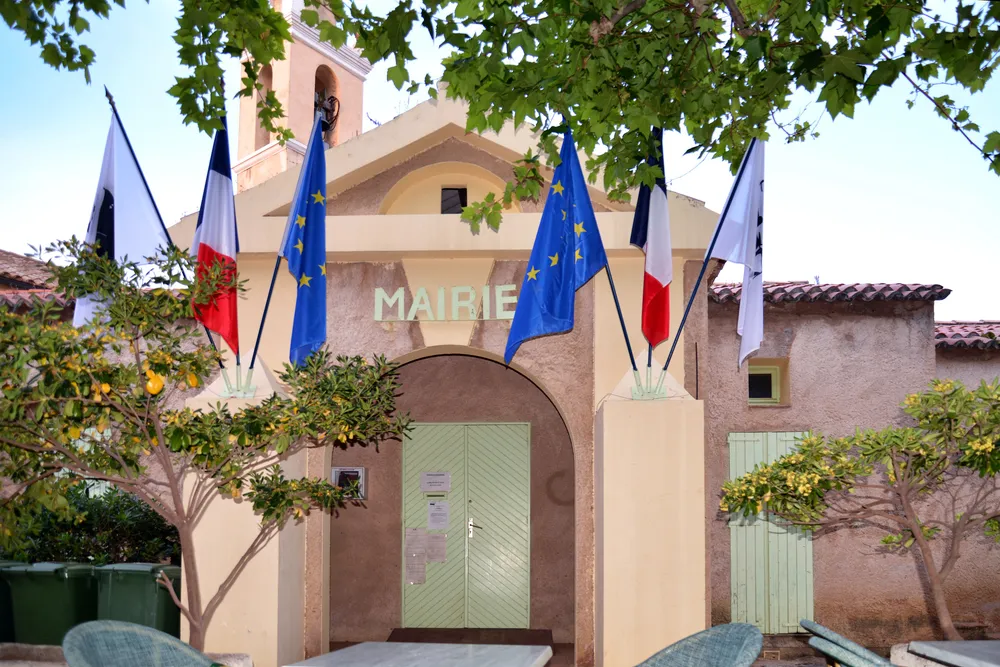 Photo : Pierre Bona, CC BY-SA 3.0, via Wikimedia Commons
To see old flags and objects decorated with the Moor’s head, the Musée de la Corse, in the citadel of Corte, is the place to go: see museums in Corsica.
Corsican flag and Sardinian flag: what is the difference?
The two flags come from the same Aragonese arms, but they are only partly alike. The flag of Sardinia, known as the Quattro Mori (Four Moors), has four Moor’s heads separated by a red cross of Saint George, on a white background. The Corsican flag keeps just one, with no cross.
The band has also moved in Sardinia. The blindfolded version appeared there around 1800, under the House of Savoy, perhaps through a copyist’s mistake. The regional law of 15 April 1999 that made the Quattro Mori the official flag of the Autonomous Region of Sardinia put the band back on the forehead and turned the heads away from the flagpole.