Corsica has more places to see than you can fit into one trip. This page sorts them by type (towns, villages, beaches, mountains, natural sites), so start from what you enjoy. For each place, a sentence or two says why to go and who it suits, followed by a link to our detailed guide. For activities, see what to do in Corsica.
Before you choose, bear the distances in mind: allow about 3 hours by road from Bastia to Bonifacio, and 4 hours from Calvi to Bonifacio, outside summer and without stops (OSRM calculation). One region seen properly beats the whole island seen from the car.
Towns
Bonifacio sits on a white limestone headland at the southern tip of the island, facing Sardinia. People come for the upper town on the edge of the cliffs and the King of Aragon’s Stairway, then walk down to the Marina to take a boat to the Lavezzi islands. A stop for everyone, on foot, ideally early in the morning in summer.
Ajaccio is Napoleon’s birthplace: the Bonaparte house, the Fesch palace and its Italian paintings, the old Genoese town. It suits those who like a lived-in town, with a beach below the citadel and the Sanguinaires islands at sunset.
Bastia is the island’s main port. The Old Port, Place Saint-Nicolas, the citadel and its Baroque churches can all be seen on foot, and the town is the starting point for a drive round Cap Corse. A good first stop if you arrive by ferry.
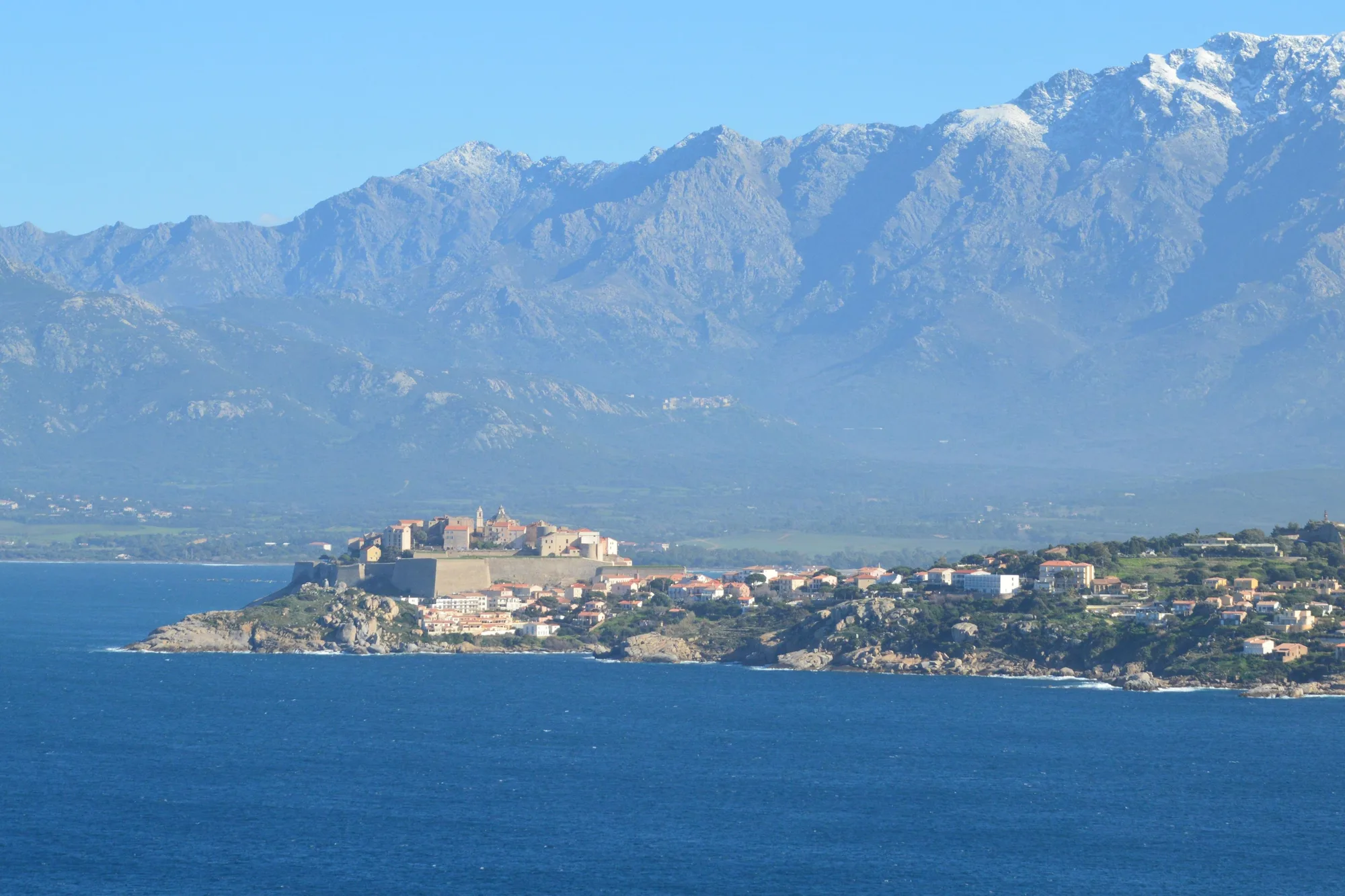
Calvi has a Genoese citadel on its rock and a bay with nearly 4 km of sand backed by pines. The town is easy to explore on foot, and it makes a base for the Balagne and for boat trips to Scandola.
Corte, in the centre of the island, was the capital of Pascal Paoli’s independent Corsica. Its citadel houses the Musée de la Corse. Come here to understand the island’s history and to head into the mountains, since the Restonica valley starts just below the town.
Porto-Vecchio has a Genoese citadel, but people mostly stay here for what lies around it: Palombaggia, Santa Giulia, Rondinara, Bavella and the Lavezzi islands are all within a day trip. It is the base for beach holidays in the south.
L’Île-Rousse was founded by Pascal Paoli opposite its red granite islets. Its shady square, covered market, railway station and beach right below the town make it an easy base, with or without a car.
Sartène, “the most Corsican of Corsican towns” according to Prosper Mérimée, is a granite town perched above the Rizzanèse valley. It will appeal to those who like old stones and prehistory, with the megaliths of Cauria close by.
Propriano, a port at the head of the Gulf of Valinco, makes a base between Ajaccio and Bonifacio: the beaches of Campomoro and Porto-Pollo, the Filitosa site, boat trips.
Villages and marinas
Porto is no more than a marina and a Genoese tower at the head of its gulf, but that gulf has been a UNESCO World Heritage site since 1983. Boats for Scandola and Girolata leave from the marina, and the Calanques de Piana are a quarter of an hour’s drive away. Choose it if you prefer scenery to nightlife.
Algajola comes down to a few lanes around a Genoese castle, beside a long sandy beach. You can walk round it in an hour. The Balagne train stops here: a good choice for families or without a car.
Saint-Florent, a Genoese marina between Cap Corse and the Agriates, revolves around its yacht harbour. People stay here to take the boat to the beaches of Lotu and Saleccia, and for the Patrimonio vineyards next door.
Erbalunga, a quarter of an hour from Bastia, packs its tall stone houses onto a point, around a small harbour and a ruined Genoese tower. It is the first stop on the drive round the Cape.
Centuri is the fishing port on the west coast of Cap Corse: boats, café terraces and the islet of Capense opposite.
Nonza stands on a sheer spur above the sea, with its square tower and, below, a long beach of black pebbles. The full drive round the Cape takes a day: our page on Cap Corse gives the stops and the driving times.
The hill villages of the Balagne (Monticello, Santa-Reparata-di-Balagna, Corbara, Pigna) look down on the sea above L’Île-Rousse and Calvi. Half a day by car is enough to see several of them; our page on L’Île-Rousse suggests where to stay to reach them.
Beaches
Corsica has beaches for every taste, and our section on the beaches of Corsica shows them on a map. Here are the ones that are worth a detour on their own.
Palombaggia, south of Porto-Vecchio, stretches for nearly two kilometres of pale sand between pines and red rocks, facing the Cerbicale islands. It lives up to its reputation if you come early in the morning in summer, or in June and September.
Santa Giulia and Rondinara have shallow turquoise water. Santa Giulia is the more practical (car park, lifeguards in summer, water sports centre); Rondinara, an almost enclosed cove, stays calm even when the open sea is rough: two safe choices with children. The other beaches in the area are on the beaches of Porto-Vecchio.
Petit Sperone and Grand Sperone, near Bonifacio, offer white sand to those willing to walk from Piantarella: about 25 minutes for Grand Sperone. Neither has lifeguards. See also the beaches of Bonifacio.
Saleccia and Lotu, in the Agriates, have no road and no buildings: you get there by boat from Saint-Florent, by 4x4 or on foot. Take water and shade. Ostriconi, at the western entrance to the area, is a quarter of an hour’s walk from the road. The details are on the beaches of the Agriates.
Sant’Ambroggio and Bodri, in the Balagne, can be reached by train. Sant’Ambroggio, with lifeguards in summer and wheelchair access, suits families well. The neighbouring beaches are on the beaches of L’Île-Rousse.
Capo di Feno, west of Ajaccio, opens a kilometre of sand onto the open sea: a surf spot, where you only swim when the sea is calm. The more sheltered beaches of the gulf are on the beaches of Ajaccio.
Barcaggio, at the end of the Cap Corse road, faces the island of Giraglia and its lighthouse, between a protected dune and a lagoon.
Mountains and hiking
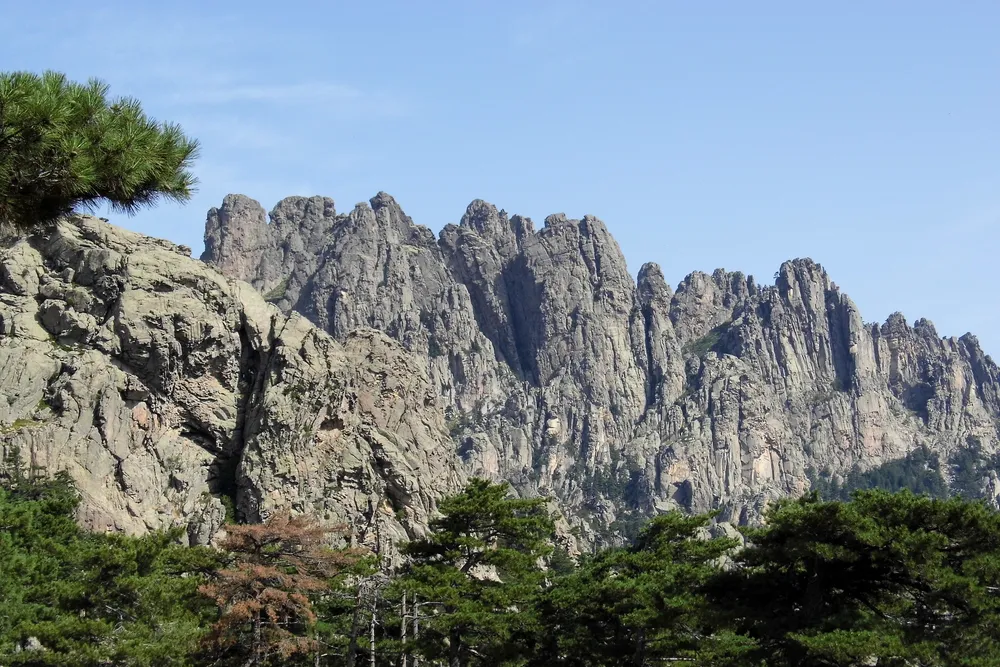 Photo : Mathieudu68, CC BY-SA 3.0, via Wikimedia Commons
The Bavella needles raise their red granite towers above the pass, at 1,218 m, which you can drive up to from Zonza or Solenzara. The view alone is enough without walking; with two hours to spare, the Trou de la Bombe path runs through the laricio pines. In July and August, arrive before 9 am.
The Restonica valley climbs from Corte towards the lakes of Melu and Capitellu. The road has been closed since 2023: a shuttle bus runs from Corte station from 1 May to 30 September 2026, booking required. The pools lower down suit everyone; the lakes are for strong walkers, over a full day.
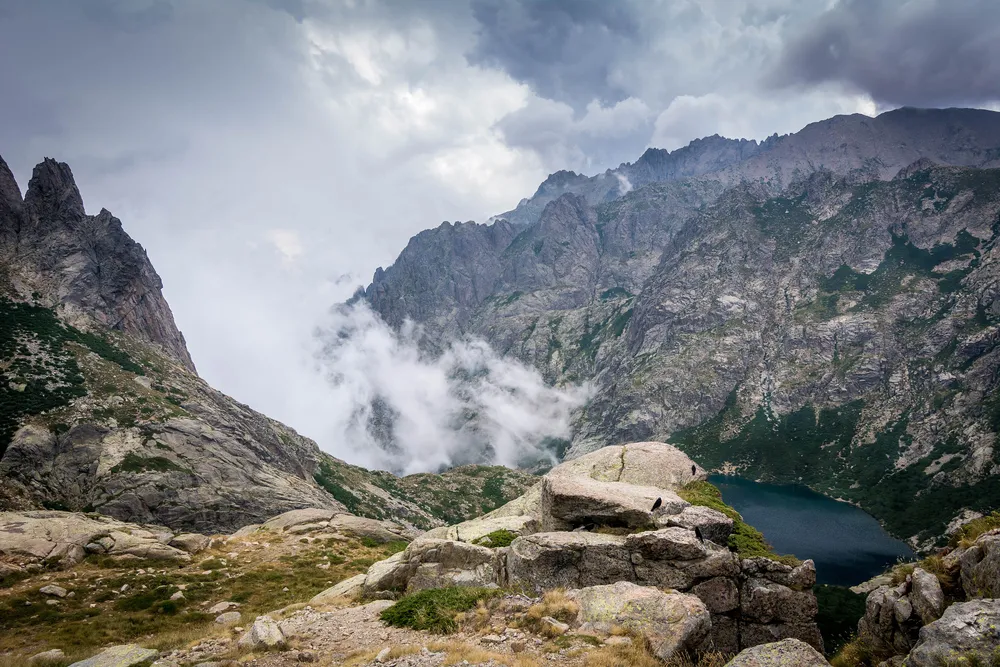 Photo : Ju2kiwi, CC BY-SA 4.0, via Wikimedia Commons
The Vizzavona forest, at the pass of the same name, mixes laricio pines and beeches along the GR20, with a station on the Ajaccio-Bastia line. From there, the Cascade des Anglais is three quarters of an hour’s easy walk away: a string of pools on the Agnone, for families or for a walk straight off the train.
The Aïtone forest, between Évisa and the Vergio pass, has shade, tall laricio pines and pools in the stream, half an hour from Porto. The walks there are short and easy.
The Scala di Santa Regina is the gorge of the Golo between Corte and the Niolu, which the D84 crosses between walls of red granite. The best of it is seen on foot, on the old mule track, in half a day.
The Coscione plateau, between 1,400 and 1,700 m, is open summer pasture, with wet grassland and free-roaming herds. Come in June for the pozzines (peat-bog pools) in flower or in October for the beeches, and turn back in fog.
Notre-Dame de la Serra, a chapel and statue of the Virgin on a promontory above Calvi, looks out over the whole bay and the citadel, a quarter of an hour away by car.
Natural sites and reserves
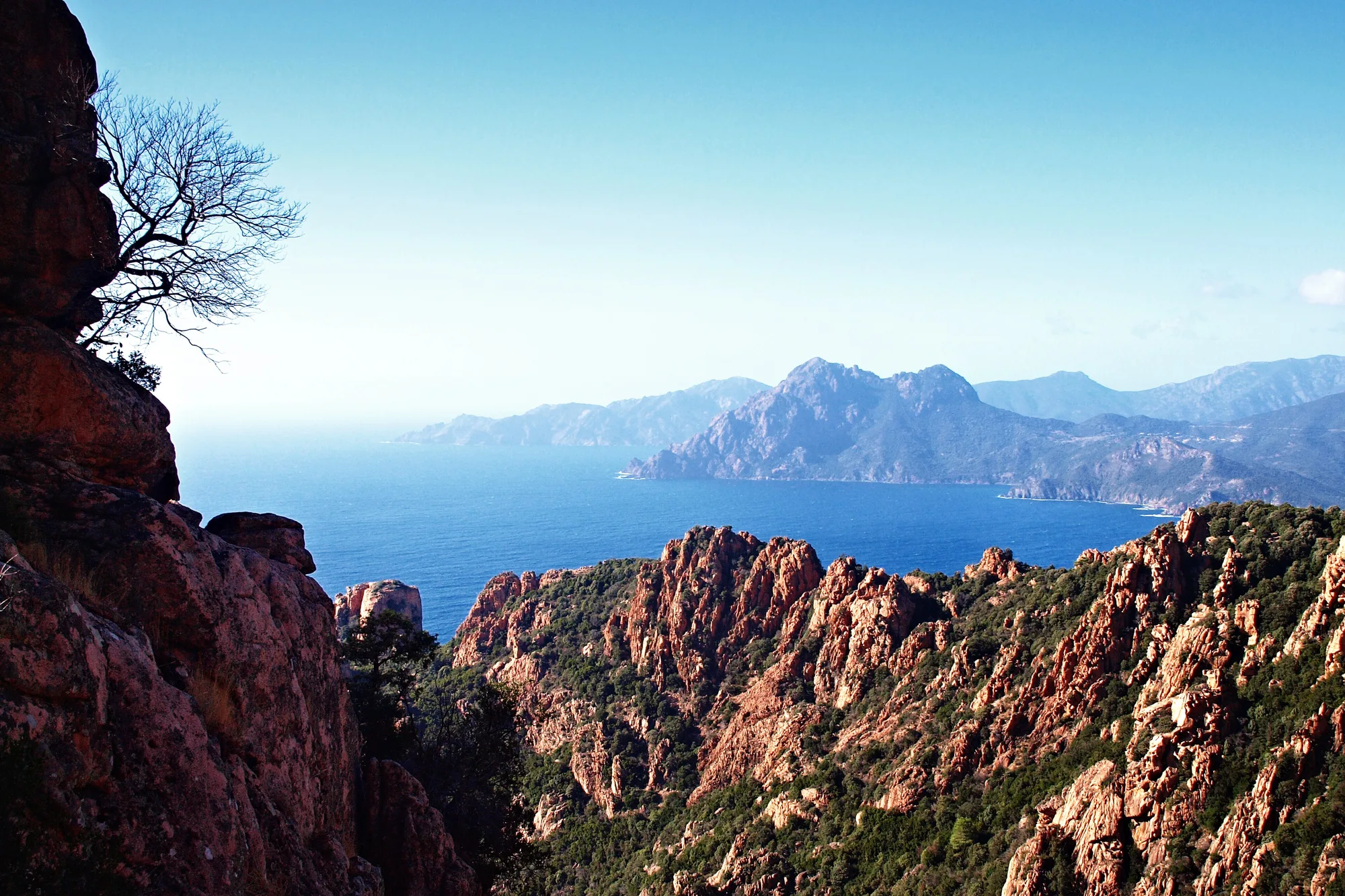
The Calanques de Piana are red granite spires above the Gulf of Porto. The D81 runs through them; park and walk along the old mule track to see them up close, or follow them by boat.
The Scandola nature reserve, an old volcano with red cliffs, can only be visited by boat, from Porto, Calvi or the south of the gulf. Go in the morning, when the sea is calm, and look for ospreys’ nests on the rock stacks.
The Gulf of Girolata hides a hamlet with no road and its small Genoese fort. You walk down through the maquis from the Col de la Croix, or arrive by boat: one for those who like walking.
The Lavezzi islands, off Bonifacio, are an archipelago of smooth granite and clear coves, protected by the Bouches de Bonifacio nature reserve. You land on the island of Lavezzu for the day, with a mask and snorkel.
The Agriates desert covers 15,000 ha of maquis with no tarmac road between Saint-Florent and the Ostriconi. You reach it by dirt track, by sea or on the coastal path.
The Roccapina lion, a rock lying above a white sandy beach, can be seen from a viewpoint on the road between Sartène and Bonifacio: a photo stop on the way.
The Cavu natural pools, half an hour from Porto-Vecchio, offer freshwater swimming between granite slabs. The other rivers to swim in are on the natural pools of Corsica.
How to choose
If this is your first trip, start with one half of the island: the south for the beaches and Bonifacio, the north-west for Calvi, the Balagne and the Gulf of Porto. Our page north or south Corsica helps you decide, and our itineraries for one week and for ten days link these places day by day. All our town pages are gathered in the destinations. To see all these places at a glance, our map of Corsica shows the towns, beaches and natural sites, each linked to its guide.